
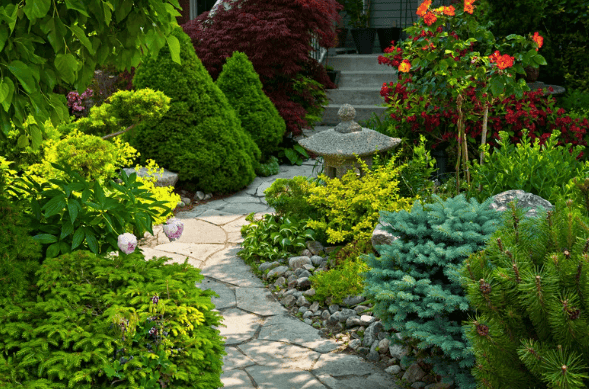
Garden Pathway Design Improvements
Durable pathway materials must endure freeze–thaw cycles, moisture, and load without compromising performance. Modular, weatherproof pavers and high‑density composites offer year‑round usability with manageable maintenance. Curved layouts should balance sightlines, turning radii, and safe transitions, while edges and lighting modulate glare and navigation cues. Edging, plant accents, and seasonal cues reinforce wayfinding. A structured maintenance and budgeting framework is essential to sustain accessibility, safety, and the intended aesthetic over time, inviting closer examination of practical strategies.
How to Choose Durable Materials for Year-Round Paths
Selecting durable materials for year-round garden paths requires evaluating performance under varying moisture, temperature, and load conditions. The analysis emphasizes modularity, long-term resilience, and ease of maintenance. Durable composites offer high strength-to-weight ratios, while weatherproof pavers resist freeze-thaw cycles and staining. Selection balances cost, availability, and installation practicality, enabling a functional, freely expressive landscape with consistent seasonal usability.
Designing Curves, Sightlines, and Accessibility Together
Curved pathways balance aesthetic expression with functional flow by aligning sightlines, human-scale perception, and accessibility requirements.
Designing curves requires disciplined alignment of visual corridors and turning radii, ensuring unobstructed views and safe transitions.
Designers integrate sightlines, accessibility together, and circulation logic, selecting durable materials for year round paths.
The result supports freedom of movement while sustaining long-term performance and ease of maintenance.
Edging, Lighting, and Plant Accents for Mood and Safety
Edges, illumination, and plant accents establish the mood of a garden path while reinforcing safety and wayfinding. Edging textures define boundaries, enhancing navigation without visual clutter. Lighting safety protocols specify uniform distribution, glare reduction, and switch placement for pedestrian comfort. Plant accents provide seasonal cues, supporting contrast and depth. Design iterations balance aesthetics with durability, accessibility, and maintenance practicality.
Maintenance, Budgeting, and Evolving Garden Pathways
Maintenance, budgeting, and evolving garden pathways require a systematic approach to sustain functionality while accommodating growth and changing user needs. The discussion emphasizes durable material life cycles, scalable maintenance plans, and cost-aware decision-making. Design teams compare modular components, predictive upkeep, and phased upgrades. Emphasis rests on maintenance budgeting and evolving pathways to preserve accessibility, safety, and aesthetic integrity over time.
Frequently Asked Questions
How Can Seasonal Color Impact Path Material Choices?
Seasonal color informs path material choices by highlighting durability and visibility; palette shifts influence pedestrian flow, especially on narrow paths, where beginner friendly tools and precise curve radii matter. Remote sensors, maintenance scheduling, eco friendly weed control, shaded paths.
What Are Pedestrian Flow Guidelines for Narrow Paths?
A narrow path permits reduced pedestrian flow and demands clear guidance; coincidence emerges as users align with sightlines. Pedestrian safety and path geometry principles prescribe width, turning radii, sight distance, and surface texture to manage movement efficiently.
See also: AI in Fraud Detection
Which Beginner-Friendly Tools Ensure Precise Curve Radii?
Beginner friendly tools ensure precise curve radii for narrow paths. They integrate remote sensors, maintenance scheduling, and eco friendly weed control. Designs consider seasonal color, path material choices, pedestrian flow, shaded paths, and overall eco-conscious aesthetics.
How Do Remote Sensors Influence Path Maintenance Scheduling?
Remote sensors influence path maintenance scheduling by providing continuous condition data, enabling proactive planning. Seasonal color and path material choices affect sensor reporting reliability, while design-focused metrics guide maintenance intervals toward efficient, freedom-filled, technically grounded outcomes.
Are There Eco-Friendly Weed-Control Methods for Shaded Paths?
Weed control on shaded paths can be eco friendly, using integrated weed suppression and mulch barriers, with minimal chemical use. This approach aligns with shaded path tactics, emphasizing design precision, sustainability, and freedom to manage landscapes responsibly, like measured steps.
Conclusion
This pathway strategy achieves near-mythic resilience, transforming every step into a high-precision guarantee of durability. By combining modular, weatherproof pavers with durable composites, curves are not merely navigable but kinetically optimized for sightlines and safe radii. Edging, lighting, and plant accents synchronize to daylight and seasonality, while a proactive maintenance and budgeting framework ensures perpetual accessibility, safety, and aesthetic integrity. In short, the design elevates year-round function to an almost legendary standard of performance.